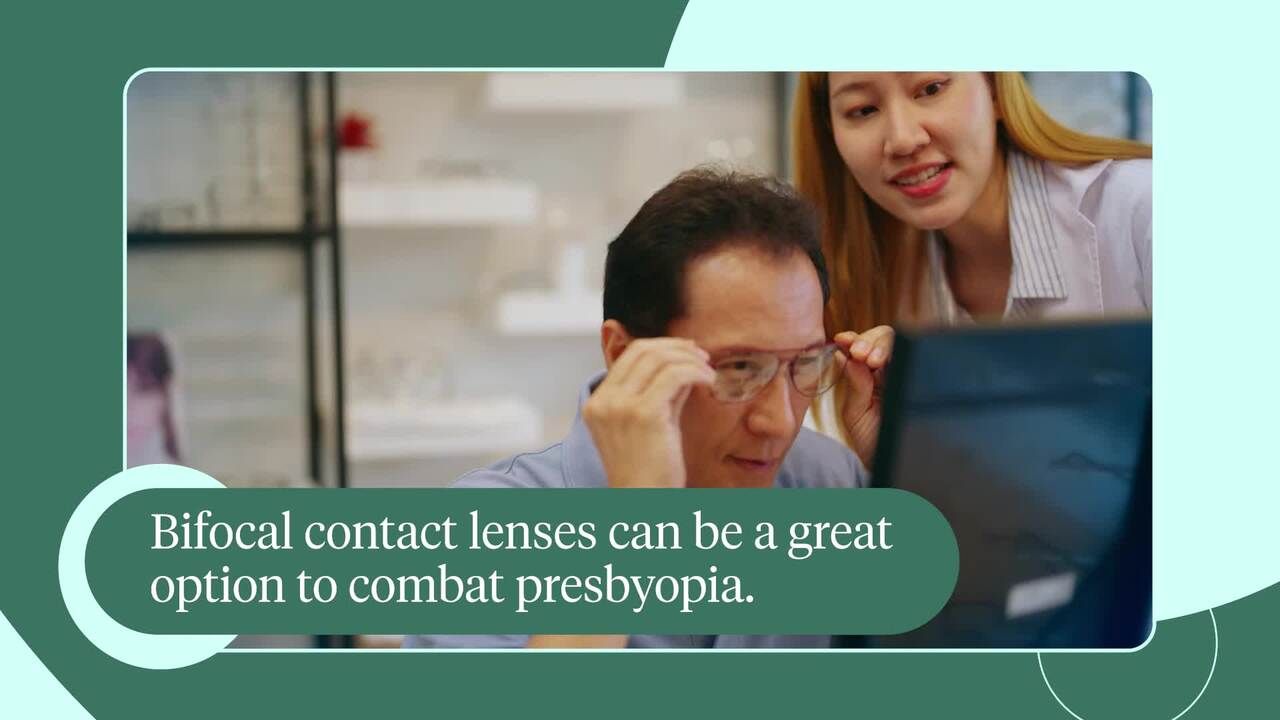


Do you find that you have to hold things farther away from your eyes to see them clearly? The problem may be presbyopia, also called farsightedness, a condition that occurs when the lenses in your eyes start to age.
With presbyopia, lenses become harder and less flexible over time. The muscles that support and control them lose strength, too, making it harder for lenses to do their job. The result? Your near vision declines, and reading and other up-close activities become more difficult and more tiring.
How to treat presbyopia
Most people experience at least some degree of presbyopia during their middle-age years. Fortunately, it's fairly easy to correct, and clearer vision can soon be yours again. But it's important to see an eye-care specialist like an ophthalmologist or optometrist first. They make sure there isn't something else causing your vision problems.
If you have presbyopia and don't already wear glasses or contacts, the specialist might recommend a pair of nonprescription reading glasses, or "readers." You can often find them drugstores for a relatively low cost.
If you already wear glasses or contacts, prescription reading glasses or a new type of contact lens may help. For example:
- Bifocals and trifocals help you see both up close and at a distance. Trifocals also correct vision at middle distances.
- Progressive lenses act like bifocals and trifocals but provide a more gradual transition between the prescriptions.
- Monovision contacts are designed so that one eye handles your distance vision while the other takes care of seeing up-close objects. These can take some getting used to.
- Multifocal lenses help both eyes see clearly up close and far away. Focus may not always be quite as clear as what can be achieved with monovision lenses.
Eye surgery, such as LASIK, can also correct presbyopia. Some procedures restore monovision, and others replace lenses with artificial ones.
Work with a professional
It's never a good idea to diagnose vision problems on your own. Whatever might be compromising your sight, your eye-care specialist is the right person to see for a solution. Don't hesitate to book an appointment if you're noticing any changes in your vision.