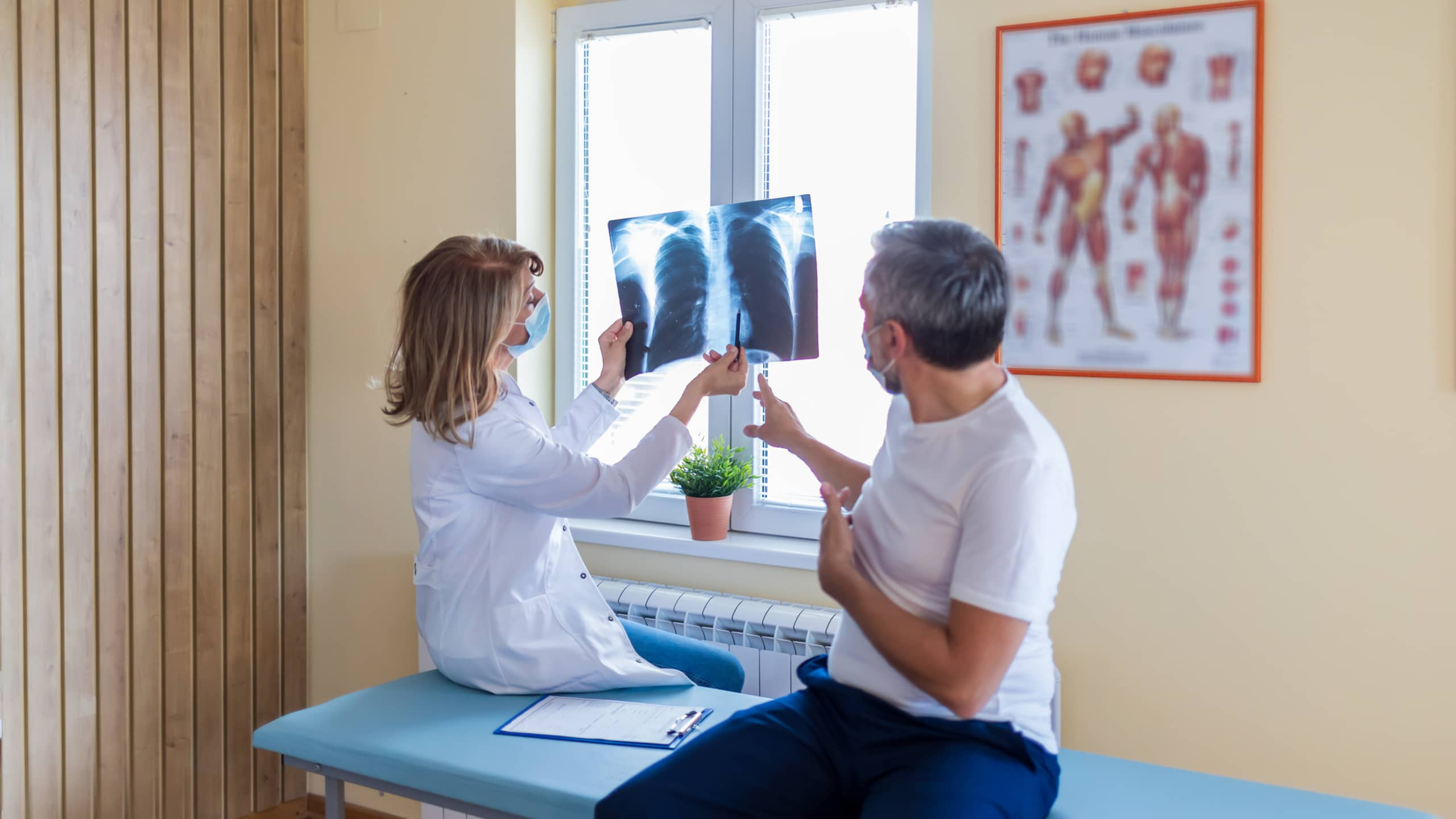
Chronic obstructive pulmonary disease (COPD) and lung cancer are serious conditions that frequently occur together. Smoking is a significant risk factor for both, but their connection goes further than tobacco use. People with COPD have much higher odds of developing lung cancer, and many lung cancer patients have coexisting COPD.
So, what is COPD exactly? How is it linked to lung cancer? And what can your healthcare provider (HCP) do to ensure your best possible outcome if you have both conditions?
What is COPD?
COPD is a chronic progressive disease characterized by a decline in lung function that makes it difficult to breathe. There are two main types. The first, emphysema, occurs when your lungs’ air sacs are damaged. The second, chronic bronchitis, is inflammation of the bronchial tubes of the lungs and damage to the respiratory cilia. It causes excess mucus production, among other symptoms.
Smoking is the top risk factor for developing COPD in high-income countries. Environmental risk factors, including exposure to industrial chemicals and dust, smoke from coal and woodfires, air pollution, and secondhand smoke also contribute to the disease. Risk increases with age, and most cases occur in people over the age of 40. COPD is considered underdiagnosed and undertreated.
What is lung cancer?
Lung cancer occurs when abnormal cells in a lung grow out of control. Like COPD, there are two primary types of the disease. Non-small cell lung cancer (NSCLC) accounts for 80 to 85 percent of cases, while small cell lung cancer (SCLC) makes up 10 to 15 percent.
How do COPD and lung cancer overlap?
While exact statistics are not known, and can vary depending on the population being studied, the prevalence of COPD among people with lung cancer can range from 40 to 70 percent. Emphysema is especially common. People with COPD are also at a higher risk of developing lung cancer, and lung cancer is the leading cause of death among people with mild-to-moderate COPD.
This overlap between the two conditions is not fully understood, but the two conditions share well-known risk factors.
As with COPD, the biggest risk factor for lung cancer is smoking. Other shared risk factors include exposure to burning fuel sources including wood, coal, oil, and gas.
Additional risk factors for lung cancer include exposure to radiation (such as radiation from previous unrelated cancer treatment) and metals (including chromium, nickel, and arsenic). Smoking combined with exposure to other carcinogens compounds the risk of lung cancer.
There is also evidence of genetic links between COPD and lung cancer, as well as evidence that the damage to the lungs that occurs with COPD drives the mutations that create cancerous cells in the lungs.
COPD is also associated with a worse prognosis for lung cancer for a variety of reasons. Tumors tend to be more malignant (more abnormal, aggressive, and likely to spread) when coexisting with COPD. The prevalence of post-surgery complications is higher, and quality of life is lower, among people with both conditions.
Working with your healthcare team
Research about the relationship between lung cancer and COPD is ongoing. This includes research seeking to explain why some people develop both conditions and the best way to approach treatment.
If you or a loved one is living with COPD, lung cancer, or both, your best source of information will be a healthcare provider. Treating lung cancer alongside COPD requires a multidisciplinary approach to care, with a team that includes oncologists, pulmonologists, and other specialists working in cooperation with one another.
Sources: Centers for Disease Control and Preventi... + 18
- Centers for Disease Control and Prevention. National Trends in COPD. Accessed Aug. 31, 2022.
- American Lung Association. Lung Cancer Fact Sheet. Page last updated: November 17, 2022.
- American Cancer Society. Key Statistics for Lung Cancer. January 29, 2024.
- Park HY, Kang D, Shin SH, et al. Chronic obstructive pulmonary disease and lung cancer incidence in never smokers: a cohort study. Thorax. 2020;75(6):506-509. doi:10.1136/thoraxjnl-2019-213732
- COPD Foundation. What causes COPD? Reviewed October 17, 2023.
- Durham AL, Adcock IM. The relationship between COPD and lung cancer. Lung Cancer. 2015;90(2):121-127. doi:10.1016/j.lungcan.2015.08.017
- American Lung Association. Emphysema. Page accessed November 23, 2022.
- American Lung Association. Chronic Bronchitis. Page accessed November 23, 2022.
- American Lung Association. Learn About COPD. Page last updated: November 17, 2022.
- American Lung Association. COPD Causes and Risk Factors. Page last updated: March 5, 2021.
- American Cancer Society. What Is Lung Cancer? January 29, 2024.
- Centers for Disease Control and Prevention. What Are the Risk Factors for Lung Cancer? Reviewed November 7, 2023.
- Zhao G, Li X, Lei S, Zhao H, Zhang H, Li J. Prevalence of lung cancer in chronic obstructive pulmonary disease: A systematic review and meta-analysis. Front Oncol. 2022;12:947981. Published 2022 Sep 16.
- Park HY, Kang D, Shin SH, et al. Chronic obstructive pulmonary disease and lung cancer incidence in never smokers: a cohort study. Thorax. 2020 Jun;75(6):506-509.
- American Lung Association. Learn About COPD. Updated July 11, 2024.
- Mayo Clinic. COPD. April 15, 2020.
- Ajimizu H, Ozasa H, Sato S, et al. Survival impact of treatment for chronic obstructive pulmonary disease in patients with advanced non-small-cell lung cancer. Sci Rep 11, 23677 (2021).
- Wang W, Dou S, Dong W, et al. Impact of COPD on prognosis of lung cancer: from a perspective on disease heterogeneity. Int J Chron Obstruct Pulmon Dis. 2018;13:3767-3776. Published 2018 Nov 20.
- Centers for Disease Control and Prevention. Lung Cancer: Screening for Lung Cancer. August 8, 2024.s